Bankroll Management for Sports Betting: A Complete Guide
By The Masaniello Team · August 28, 2026
What Is a Betting Bankroll?
A betting bankroll is money set aside for betting, and only for that. It isn't your current account balance, and it isn't money you'd miss if it disappeared tomorrow.
Two things separate a bankroll from ordinary spending money. It is fixed in advance, decided before you place a bet rather than after a losing week when you're tempted to top it up from elsewhere. And it is fully separate from living costs. Rent, food, and debt repayments come out of a different pot entirely. If a loss on your bankroll affects your ability to pay a bill, the bankroll was never sized correctly in the first place.
Serious bettors treat the bankroll as risk capital, in the same way a trader treats trading capital as separate from savings. The amount matters less than the discipline around it. A £200 bankroll managed properly will outlast a £2,000 bankroll bet without a plan.
This distinction is the foundation everything else in this guide depends on. Unit sizing, staking plans, and risk of ruin calculations are meaningless if the bankroll itself is not a clearly defined, ring-fenced amount.
How to Size Your Betting Bankroll
There is no fixed bankroll size that works for everyone. The right number depends entirely on disposable income, not on a target you've seen quoted elsewhere.
A working definition: your bankroll should be an amount you could lose in full without it changing how you live. Not an amount that would sting. An amount you could lose completely and still pay every bill on time next month.
Take your monthly disposable income, meaning what's left after rent, bills, food, debt repayments, and savings contributions. Set aside a small percentage of that, typically between 5% and 10%, as your betting bankroll for the month. On a disposable income of £400 a month, that puts a bankroll between £20 and £40. On £1,000, between £50 and £100. The percentage stays constant. The amount scales with income.
Two mistakes come up constantly at this stage. Sizing the bankroll from total income rather than disposable income: someone earning £2,500 a month with £2,300 of fixed costs has £200 of disposable income, not £2,500. The bankroll comes from the £200. And treating the bankroll as a one-off deposit rather than a recurring allocation. A bankroll refilled from your current account whenever it runs low isn't a bankroll. It's just spending with extra steps.
Once the bankroll size is fixed, the next decision is how much of it goes on any single bet. That's what unit sizing covers.
What Is a Betting Unit?
Ask any bettor who's been doing this for years how much they bet, and they won't quote you a pound figure. They'll say "two units" or "half a unit on that one." That's not affectation. It's the whole point of bankroll management.
A unit is a fixed slice of your bankroll, usually somewhere between 1% and 5%, that becomes your standard bet size. Once it's set, you stop thinking in pounds and start thinking in units. That's the shift that actually protects a bankroll, because pound amounts tempt you into moving the goalposts mid-losing streak. Units don't move unless you decide to move them.
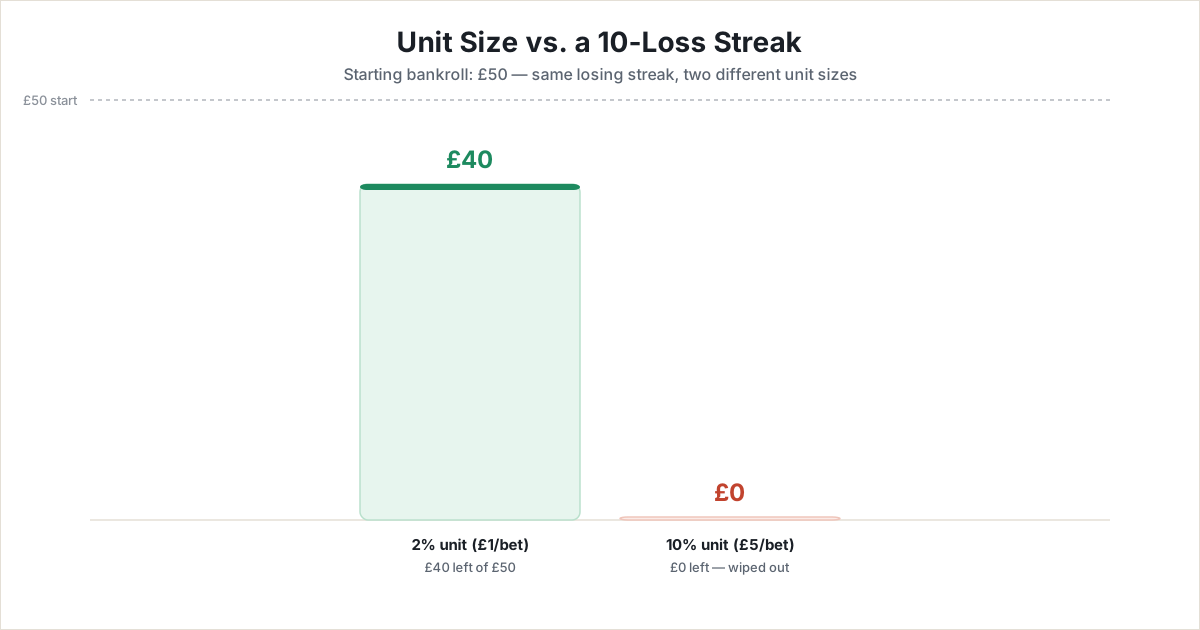
Take a £50 bankroll with a 2% unit. That's £1 a bet. Sounds small, and it is small on purpose. A run of ten straight losses, which happens more often than most bettors expect, costs £10. Twenty percent of the bankroll gone, but the bankroll survives to keep going. Set that same £50 bankroll at 10% units and the same ten-loss run wipes it out completely.
Most staking guidance sits between 1% and 5% units, with 2% being the figure that comes up most often among bettors who've actually stuck around long-term. Higher than that and normal variance starts doing real damage. Lower than that and growth slows to the point where it barely feels worth doing.
Confidence in a particular bet doesn't change the unit. Bookmakers price in confidence already, through the odds. A short-priced favourite at 1.30 (3/10) already reflects how likely it is to win. Doubling your unit on it doesn't add insight. It adds risk you haven't accounted for.
Flat Betting Strategy Explained
Flat betting is the simplest staking method there is. You pick a unit, say 2% of your bankroll, and you bet that exact unit on every single bet. Win or lose, the next stake doesn't move.
Most losing bettors aren't losing because their picks are bad. They're losing because their stake size swings around depending on mood, confidence, or how the last bet went. Flat betting removes that variable completely.
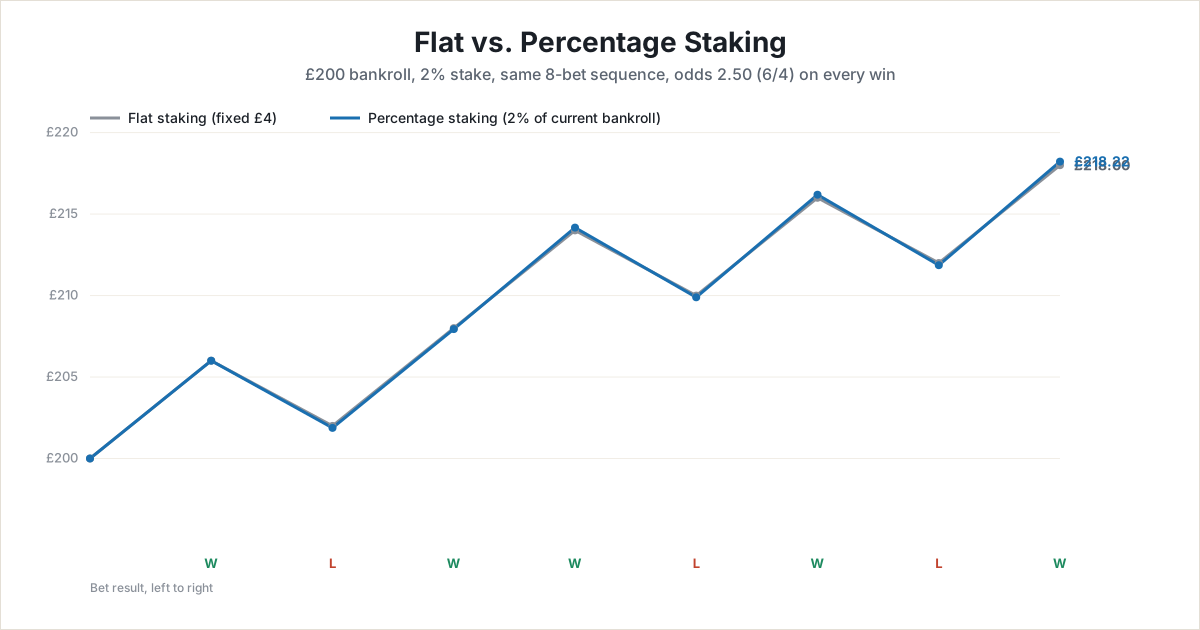
Say the bankroll is £200 and the unit is £4 (2%). A bet at 2.50 (6/4) wins, and the bankroll is now £206. The next bet is still £4, not £4.12 recalculated off the new balance, and not bumped up to £8 because the last one landed. Same £4, every time, regardless of what just happened.
The appeal of flat staking for a sports betting strategy is that it makes results easy to read. If the bankroll is up after 100 bets, the picks were good. There's no staking noise clouding the picture. Percentage-based and Kelly-based methods are more efficient in theory, but they mix staking performance and pick performance together, which makes it harder to tell which one is actually working for you.
The drawback is that flat staking doesn't compound. A £4 unit stays £4 whether the bankroll has grown to £400 or shrunk to £40, unless you manually recalculate the unit at set intervals. That's the exact reason percentage-based staking exists.
Percentage Betting Strategy (Proportional Staking)
Percentage betting, also called proportional staking, fixes the percentage instead of the pound amount. The stake is always 2% of whatever the bankroll currently is, not 2% of what it was when you started.
Run the same £200 bankroll at a 2% proportional stake. Bet one is £4, same as flat staking. It wins at 2.50 (6/4), the bankroll moves to £206, and the next stake recalculates to £4.12, which is 2% of the new total. Lose a run of bets instead, and the stake shrinks with the bankroll, so a bad week never risks a fixed £4 against a bankroll that's already down to £150. It risks £3, because 2% of £150 is £3.
A losing streak automatically bets smaller as it goes on, instead of staying flat while the bankroll under it keeps shrinking. It doesn't protect you from a losing streak. Nothing does. It just makes sure the streak costs less as it continues.
The trade-off is precision. Recalculating a stake after every single bet is impractical by hand across a full season. In practice, most bettors round to the nearest pound and recalculate weekly or monthly rather than bet by bet. Percentage staking still treats every bet the same regardless of your actual edge on it, which is what the Kelly Criterion is built to fix.
Kelly Criterion Betting Strategy
Every method so far treats every bet the same size regardless of how strong the edge is. Kelly Criterion sizes the stake to the size of the edge, mathematically, using the formula f* = (bp − q) / b. b is what you win per pound staked, which is decimal odds minus one. p is your genuine estimate of the win probability, not the bookmaker's. q is 1 minus p.
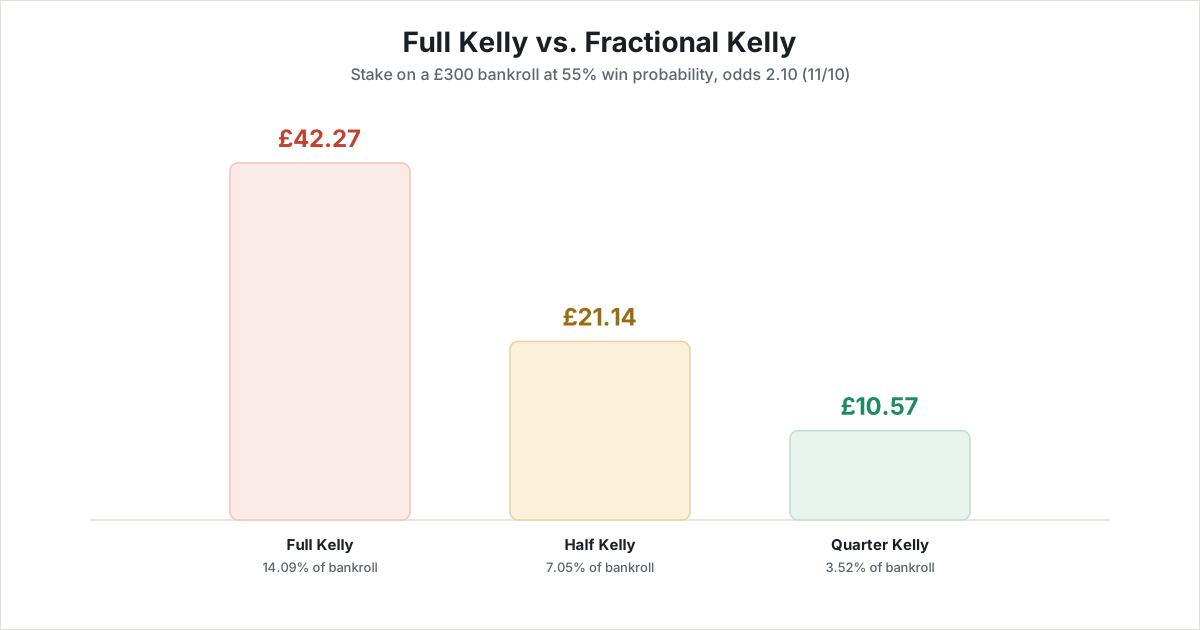
Say you've priced a game at 55% to win, and the bookmaker's got it at 2.10 (11/10). b works out to 1.10. Run the numbers: (1.10 × 0.55 − 0.45) ÷ 1.10 comes out to 0.1409. Kelly is telling you to stake just over 14% of the bankroll on that single bet.
Nobody sane bets 14% of a bankroll on one football match, and here's why full Kelly almost never gets used in practice: it assumes your 55% estimate is exactly right, every time, forever. Overestimate your edge by even a couple of points and full Kelly stakes start bleeding a bankroll out fast.
That's why half Kelly and quarter Kelly exist. Take that same 14.09% and halve it to 7.05%, or quarter it to 3.52%. On a £300 bankroll, full Kelly says stake £42.27. Half Kelly brings that to £21.14. Quarter Kelly to £10.57, which lands close to the 2 to 5% unit range flat and percentage bettors already use.
The real bottleneck with Kelly has nothing to do with the formula. It's p. Getting the formula right is trivial. Getting an honest, unbiased win probability for a football match is the actual skill, and it's one most bettors overrate their own ability to do.
Target-Based Staking Cycles (The Masaniello System)
Flat, percentage, and Kelly staking all price bets one at a time. Target-based staking cycles work differently. Instead of sizing single bets, you set a target across a fixed run of events, for example 6 wins from the next 10 bets, and the stake for each individual bet gets calculated to keep the whole cycle on pace to hit that target.
This is where the Masaniello system sits, built by Ciro Masaniello and Massimo Mondò. The mechanic: define a bankroll, a number of events in the cycle, and a realistic number of wins needed from those events. The stake on event one gets calculated from all three inputs together. After each result, every remaining stake in the cycle recalculates, based on the bankroll left, the events left, and the wins still needed.
A 2% flat stake doesn't know it needs 6 wins from 10 events to hit target. It just bets 2% regardless. A Martingale increases the stake after a loss, chasing the loss back. A staking cycle recalculates in both directions, based on the target, not based on chasing anything.
The trade-off for this precision is that the maths gets genuinely hard to do by hand, which is the actual reason a dedicated staking calculator exists for this method rather than a spreadsheet formula most bettors could improvise themselves.
Common Bankroll Management Mistakes
Chasing a loss.A bet goes down, and the next stake goes up to "get it back quicker." This is the single most reliable way to turn a manageable losing week into a wiped-out bankroll.
Topping the bankroll up mid-month.The bankroll runs low, so £30 gets moved across from the current account to keep going. Do that twice and the bankroll stops meaning anything, because it's no longer a fixed, ring-fenced amount.
Betting your gut feeling on stake size.A bet "feels" like a lock, so the unit doubles for that one. The odds already price in how likely a result is.
Mixing staking methods without a plan.Flat one week, percentage the next, doubling up after a bad run. Each method works because it's applied consistently.
Never reviewing the bankroll size itself. Income changes. Circumstances change. Bettors who never revisit that number are usually the ones betting either too scared or too aggressive relative to where they actually stand now.
Every one of these is a discipline problem rather than a knowledge problem. Nobody blows a bankroll because they didn't know what a unit was. They blow it because they knew and didn't stick to it under pressure.
How to Build a Bankroll Management Plan
- Work out your real disposable income.Not your salary. What's left after rent, bills, food, and debt.
- Set your bankroll at 5-10% of that monthly figure. Round it to a number you're comfortable losing in full.
- Pick your unit size.2% is the figure most bettors who've stuck around long-term settle on.
- Choose one staking method and commit to it for a full month minimum. Flat, percentage, or a staking cycle. Not all three at once.
- Log every single bet. Stake, odds, result, running bankroll total.
- Set a review date, not a review trigger. Monthly works for most people.
- On review day, check three things. Has income changed? Is the unit still being followed? Is the staking method actually being stuck to?
Key Takeaways
- Bankroll: a fixed, ring-fenced amount, sized off disposable income, never off total income.
- Units, not pound guesses, are what actually protect a bankroll. 2% is the figure most long-term bettors land on.
- Flat betting gives the clearest read on pick quality. Percentage staking compounds automatically. Kelly Criterion sizes the stake to your actual edge.
- Target-based staking cycles, like the Masaniello system, work toward a defined win target across a run of events.
- Chasing losses and topping up a bankroll mid-month are the two fastest ways to wipe out an account.
Every method here only works once the bankroll behind it is sized properly and left alone to do its job. Run your own numbers through the Masaniello calculator before your next bet, rather than doing the recalculations by hand.