A single golf tournament can list an outright winner, finishing-position markets, matchups, round leaders and cut markets. Each one pays and settles under its own terms. Full fields can reach 156 players, so the market you pick has a large effect on how often a bet wins and what it pays.
This guide covers the main types of golf bets: outright winner, each-way, top 5, top 10 and top 20, head-to-head, 3-ball, make the cut and first round leader. It explains how tie rules change payouts and finishes with a staking sample for fixed-cycle plans. All odds are in decimal format. For reference, 5/1 fractional and +500 American both equal 6.00 decimal.
Golf Outright Betting Explained
An outright bet backs one golfer to win the tournament. Second place loses. A golfer who beats 154 of the 156 players in the field still produces a losing ticket. Outrights pay the most of any golf bet and hit rarely, and golf offers some of the most generous odds in sports betting.
Sample calculation: 10 units on a golfer at 26.00 decimal returns 260, a profit of 250. The implied probability of that price is 1 ÷ 26.00 = 3.85%. A bettor breaks even with flat stakes only if the golfer wins 3.85% of the time. Across 10 bets at that price, the break-even expectation is 0.385 wins. At a 3.85% hit rate, the chance that 10 independent bets contain no winner is 67.6%.
Outright betting suits small stakes spread across several golfers, and the bankroll has to cover long stretches without a return.
Each-Way Golf Betting Explained
An each-way bet is two equal stakes, one on the golfer to win and one on the golfer to place. A 10 unit each-way bet costs 20 units. The win part pays at the full odds if the golfer wins. The place part pays at a fraction of the odds if the golfer finishes inside the paid places.
Golf each-way terms are usually five places at one fifth of the odds, and bookmakers extend this for big tournaments, sometimes to 12 places. The place odds in decimal are 1 + (win odds − 1) × the place fraction.
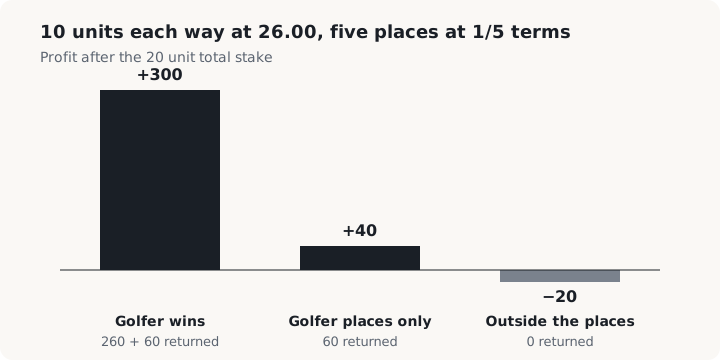
Sample calculation: 10 units each way on a golfer at 26.00, with five places at 1/5 terms, gives place odds of 1 + 25 × 0.2 = 6.00.
- Golfer wins: 260 from the win part plus 60 from the place part returns 320, a profit of 300.
- Golfer places only: 60 returned, a profit of 40.
- Golfer finishes outside the places: both parts lose, 20 units.
At 1/4 terms the place odds are 1 + 25 × 0.25 = 7.25. A place-only result then returns 72.50, a profit of 52.50.
Terms differ between bookmakers. For one major championship, a comparison of bookmaker terms listed place counts from 5 up to 12, and books paying more places generally gave shorter place odds. Check the place count and the fraction before betting, because both change the payout.
US sportsbooks mostly skip each-way and list top 5, top 10 and top 20 markets as separate bets. Compare the two. If a separate top 5 price for the same golfer is higher than the 6.00 place odds above, the separate market pays more for the same result.
Golf Top 5, Top 10 and Top 20 Bets
Finishing position bets back a golfer to finish inside a certain spot rather than win outright. Top 5, top 10 and top 20 are among the most popular golf bets. A golfer has to finish inside the stated number of places at the end of the tournament, so these bets win more often than outrights and pay less.
Ties affect these markets. More than five players can finish inside the top 5 and more than 10 inside the top 10, because ties at the cutoff are allowed. Some books list top finish markets including ties and others list them not including ties. The next section covers how each version settles.
Top 5, 10 and 20 markets carry a higher margin than a typical head-to-head matchup. The margin is built into the price, so compare prices for the same golfer across books.
Sample calculation: the prices below are illustrative for one golfer, not quoted odds. A bet of 10 units in each market returns:
| Market | Decimal odds | Implied probability | Return | Profit |
|---|
| Top 5 | 9.00 | 11.11% | 90 | 80 |
| Top 10 | 5.00 | 20.00% | 50 | 40 |
| Top 20 | 2.50 | 40.00% | 25 | 15 |
A wider market raises the implied probability and lowers the payout. The top 20 bet at 2.50 breaks even at a 40% hit rate, which is 4 wins in 10 bets.
Golf Dead Heat Rules Explained
A dead heat happens when two or more participants finish exactly even, and it comes up far more often in golf betting than in the sport it is named after. Ties at the last paying position affect top 5, top 10 and top 20 bets, first round leader bets and 3-ball matchups.
At most sportsbooks the payout is reduced in proportion to the number of tied players, and some books pay these bets in full. The reduced payout is calculated as follows: stake × (paying positions left ÷ players tied) × decimal odds.
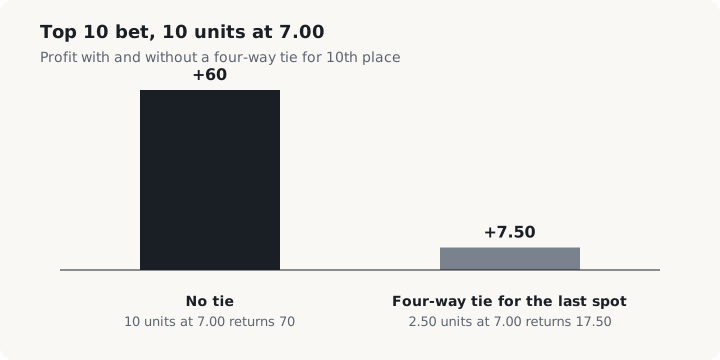
Sample calculation: 10 units on a golfer to finish top 10 at 7.00. Four golfers tie for 10th, which leaves one paying position shared by four players.
- Without a tie, the bet returns 70, a profit of 60.
- With the four-way tie, the winning stake is 10 × 1 ÷ 4 = 2.50. That returns 2.50 × 7.00 = 17.50, a profit of 7.50.
The bet wins in both cases and the profit differs by 52.50.
Some books list a second version of each market. A "Top X Finish Incl. Ties" market does not settle under dead heat reduction and pays the odds quoted at placement regardless of ties. The ties-included version carries worse odds. A top 20 price of +400 without tie protection might be +315 with ties included. In decimal that is 5.00 against 4.15, which changes the implied probability from 20.00% to 24.10%. A bet of 10 units returns 50 against 41.50 when the golfer finishes clear of any tie.
Ties-included pricing helps in weeks when many players tie at the cutoff and costs money in weeks when nobody ties at that spot. Read the market name and the settlement rules before placing the bet.
Golf Head-to-Head and 3-Ball Betting
A head-to-head matchup pits two golfers against each other and you pick who finishes better. The matchup can cover the full tournament or a single round. A 3-ball covers three golfers. It is a bet on which of the three players in a group posts the lowest score for that round only. Some books also price a mythical 3-ball, where the book picks three players from different groups.
Ties decide how these bets settle.
- In a two-ball bet, a tie is typically a push and the stake is refunded. Some books list the tie as a separate betting option.
- If the golfers finish level and no tie price is offered, some books apply dead heat rules, so half the stake is paid at full odds.
- In a 3-ball, dead heat rules apply when players tie for the lowest score, and a two-way tie cuts the effective stake in half.
Sample calculation: the prices below are illustrative. A head-to-head at 1.90 has an implied probability of 52.63%. A bet of 10 units settles three ways.
- Your golfer finishes ahead: 19 returned, a profit of 9.
- Tie settled as a push: 10 returned, a profit of 0.
- Tie settled by dead heat: 5 units win at 1.90 and return 9.50, a loss of 0.50.
A 3-ball at 3.00 has an implied probability of 33.33%. A bet of 10 units settles as follows.
- Your golfer posts the lowest score alone: 30 returned, a profit of 20.
- Two players tie for the lowest score: 5 × 3.00 = 15 returned, a profit of 5.
- All three tie: 10 ÷ 3 × 3.00 = 10 returned, a profit of 0.
Withdrawal rules vary by book, and the most common standard is that all bets stand once a player has teed off. The 3-ball also carries a higher margin than the 2-ball at most books.
Make the Cut and First Round Leader Bets in Golf
Make or miss the cut
Most PGA Tour tournaments cut the field after two rounds so the top players compete on the weekend. The exact number of golfers who make the cut varies by event. A make or miss the cut bet is a two-way wager on whether a specific golfer survives the cut and plays the weekend. Cut markets hit more often than outrights.
Sample calculation: the prices in this section are illustrative. A make the cut bet at 1.50 has an implied probability of 66.67%. A bet of 10 units returns 15, a profit of 5. Over 10 bets at that price, break-even requires 6.67 winning bets.
First round leader
A first round leader bet is a wager on the golfer who posts the lowest score in the first round, usually on Thursday. Prices are long because of the size of the field and the variance of a single day. The bet settles at the end of the opening round, so there is no wait for four rounds. Some books also list top 5 and top 20 markets for the first round.
Dead heat rules apply because the lead can be shared.
Sample calculation: a first round leader bet at 51.00 has an implied probability of 1.96%.
- Golfer leads alone: 10 units return 510, a profit of 500.
- Two golfers share the lead: the stake becomes 5 and returns 255, a profit of 245.
Over 10 bets at 51.00, break-even is 0.196 winning bets.
Golf Betting Staking Plan With Masaniello
A Masaniello cycle needs three inputs: the number of bets, the number of expected wins and the average odds. The expected wins come from your own estimate of the hit rate, so the market has to produce enough winning bets to support that estimate.
Outrights fit poorly. A cycle that expects 5 wins in 10 bets needs a 50% hit rate, and a 26.00 outright price implies 3.85%. Top 20 bets at 2.50 imply 40%. Head-to-head matchups at 1.90 break even at 5.26 wins in 10 bets, and make the cut bets at 1.50 break even at 6.67.
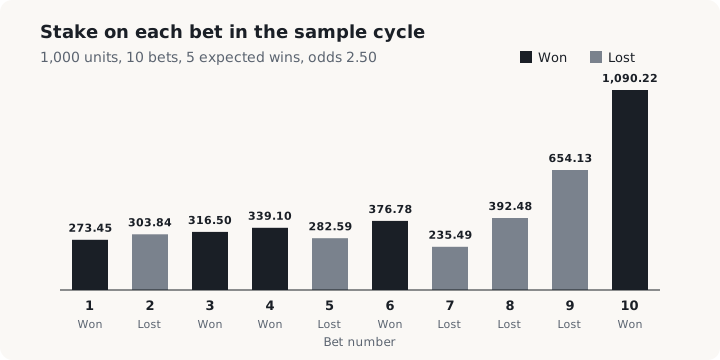
Sample calculation: 1,000 units, 10 bets, 5 expected wins and average odds of 2.50, which matches a series of top 20 bets. No safety cap and no take-profit target are set. If exactly 5 of the 10 bets win, the final bankroll is 2,725.55 units, a multiple of 2.73x and a profit of 1,725.55.
| Bet | Result | Stake | Bankroll after |
|---|
| 1 | Won | 273.45 | 1,410.18 |
| 2 | Lost | 303.84 | 1,106.34 |
| 3 | Won | 316.50 | 1,581.09 |
| 4 | Won | 339.10 | 2,089.74 |
| 5 | Lost | 282.59 | 1,807.15 |
| 6 | Won | 376.78 | 2,372.32 |
| 7 | Lost | 235.49 | 2,136.83 |
| 8 | Lost | 392.48 | 1,744.35 |
| 9 | Lost | 654.13 | 1,090.22 |
| 10 | Won | 1,090.22 | 2,725.55 |
The cycle staked 4,264.58 units in total, with 2,396.05 on winning bets and 1,868.53 on losing bets. Stakes rise as the bets run out, and bet 10 stakes the whole bankroll of 1,090.22 because one win is still needed from one remaining bet.
The same plan carries a risk that flat staking does not. Flat stakes of 100 per bet profit 250 on 5 wins (1,250 returned on 1,000 staked) and break even on 4 wins. This sample has no safety cap, so 4 wins or fewer ends with the bankroll at 0. The calculator has a "Set a safety cap on stakes" option for limiting the size of a single stake. Use the Masaniello Betting System, Bankroll Management for Sports Betting and Risk of Ruin: How Much to Stake Per Bet guides to size a cycle before you run it.
Key Takeaways
- An outright bet loses when the golfer finishes second, and a 26.00 price implies a 3.85% chance.
- Each-way costs two equal stakes. At 1/5 terms, a 26.00 outright has place odds of 6.00, and bookmakers differ on the place count and the fraction.
- Wider finishing markets pay less. A top 20 price of 2.50 implies 40%, which is 4 wins in 10 bets to break even.
- A four-way tie for the last paying spot cuts a 7.00 top 10 return from 70 to 17.50. Ties-included markets avoid that cut and quote shorter odds, such as 4.15 against 5.00.
- A tied head-to-head is a push at some books and a half-stake settlement at others. A two-way tie for the lowest score in a 3-ball halves the stake.
- A first round leader price of 51.00 implies 1.96%, and a shared lead is settled under dead heat rules.
- A Masaniello cycle of 10 bets, 5 expected wins and 2.50 odds finishes at 2.73x with exactly 5 wins. Without a safety cap, 4 wins or fewer ends at 0.
Pick the golf market first, because its odds and tie rules set what the cycle can deliver. Open Run the Numbers and enter 1,000 as the bankroll, 10 total bets, 5 expected wins and 2.5 average odds to reproduce the table above. Then change the odds to match the market you plan to bet, and tick "Set a safety cap on stakes" to compare the stakes with and without it.